
Topic 1: EQUITY: BULL ASSAULT
April 2026 marked a powerful turnaround for Indian equity markets, with benchmark indices staging their strongest monthly rally in nearly 28 months after the sharp correction witnessed in March. The Nifty 50 surged by 7.46% during the month, while the BSE Sensex climbed 6.90%, reversing a significant portion of the more than 11% decline recorded in the previous month. This recovery was not just limited to index performance; it was also reflected in a dramatic expansion of overall market wealth. The total market capitalization of all domestically listed companies jumped by nearly ₹51 trillion, reaching an unprecedented ₹463.3 trillion—marking the highest absolute monthly addition ever recorded in Indian market history and surpassing the previous peak increase of ₹28.9 trillion seen in March 2025. The scale and speed of this rebound highlighted the resilience of domestic markets despite persistent global uncertainties and continued selling pressure from foreign investors.
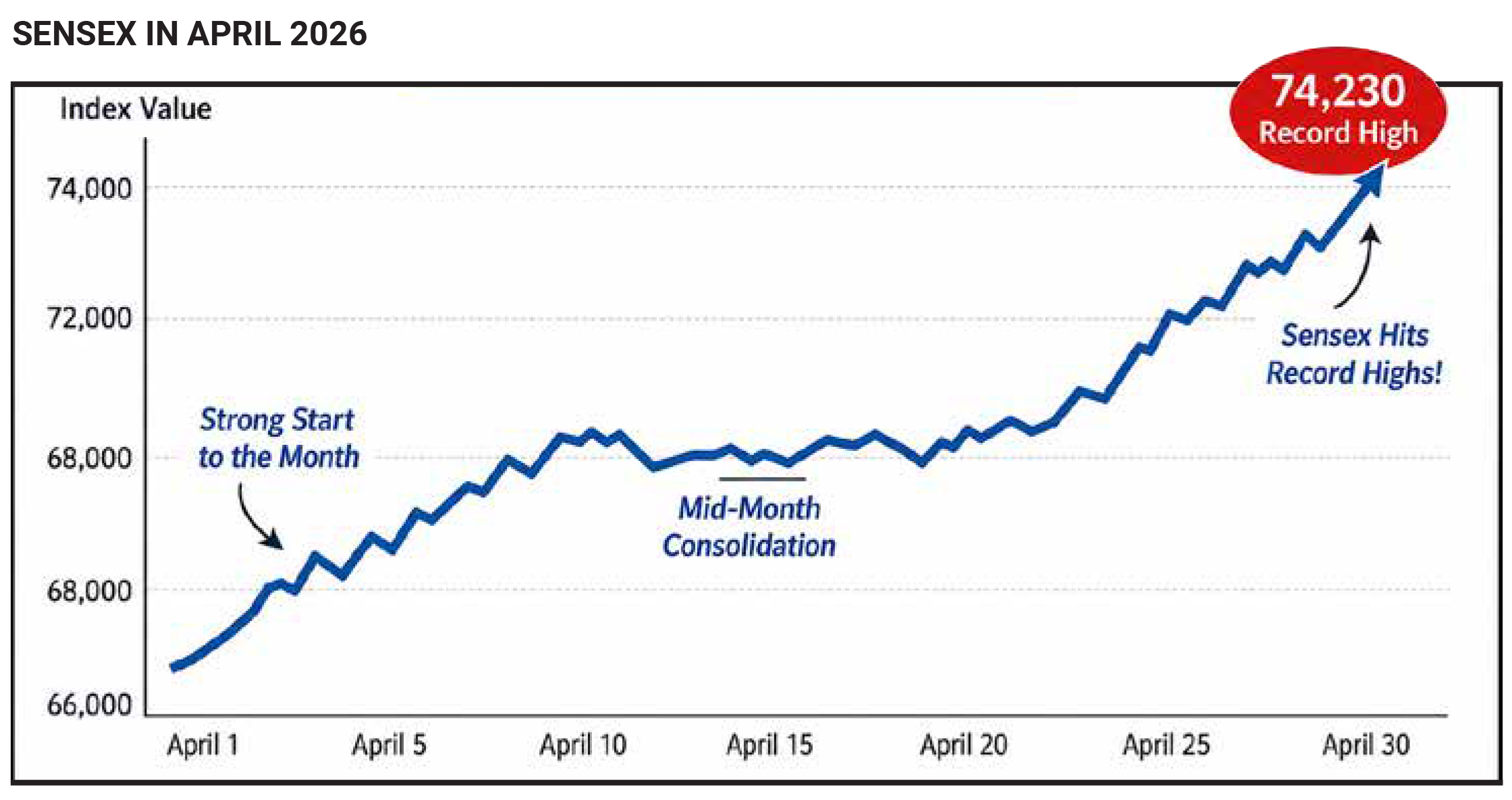
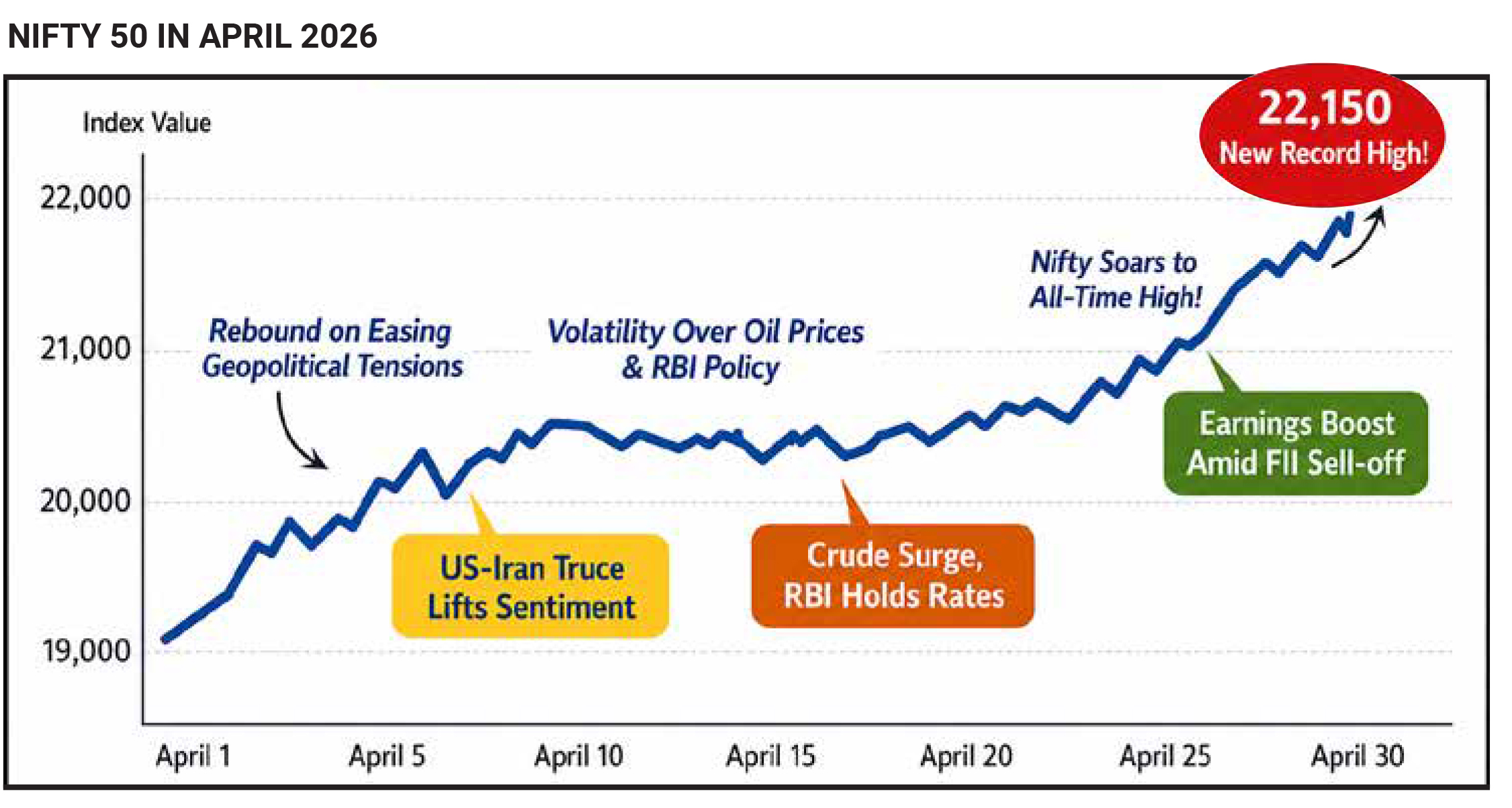
The beginning of April, however, was far from optimistic.
Markets opened the month on a weak note, with indices
declining sharply due to heightened geopolitical
tensions, elevated crude oil prices, and aggressive
foreign institutional investor (FII) outflows. On April 2, the
indices dropped more than 2% in a single session,
reflecting widespread panic triggered by escalating
conflict in West Asia, particularly involving the United
States and Iran. This geopolitical shock had already
rattled markets in March, pushing Brent crude oil prices
above $100 per barrel and intensifying concerns over
inflation, current account deficits, and monetary
tightening in India. However, as the month progressed,
sentiment began to gradually shift. By mid-April, reports
of a ceasefire or de-escalation in tensions between the
United States and Iran helped restore confidence in
global markets. This easing of geopolitical risk acted as
a major catalyst for the rebound in Indian equities.
One of the most crucial macroeconomic variables
influencing market behaviour during this period was
crude oil. India, being a major importer of oil, is highly
sensitive to fluctuations in global crude prices. In early
April, Brent crude hovered in the range of $106–110 per
barrel, raising fears of imported inflation and potential
policy tightening by the Reserve Bank of India. However,
as geopolitical tensions eased, crude prices stabilised
and began to soften slightly, reducing the immediate
pressure on the Indian economy. By early May, Brent
crude had eased to around $107.9 per barrel, providing
further relief to investors. This stabilisation played a key
role in improving sentiment, particularly in rate-sensitive
sectors such as banking, automobiles, and real estate,
which had been heavily impacted during the March
sell-off.
Another important factor shaping market dynamics was
global monetary policy, especially the stance of the
Federal Reserve. Amid rising inflation risks linked to
geopolitical developments, the Federal Reserve chose to
keep interest rates unchanged, while also signalling that
rate cuts in 2026 were unlikely. This created intermittent
pressure on global equity markets, including India, as
higher-for-longer interest rates tend to reduce liquidity
and dampen risk appetite. Despite this, Indian markets
demonstrated relative resilience, supported by strong
domestic fundamentals and investor participation.
Sectoral trends also played a significant role in driving
the April rally. In the latter half of the month, strong
buying was observed in sectors such as fast-moving
consumer goods (FMCG), automobiles, and real estate.
Leading companies including ITC Limited, Tech
Mahindra, Maruti Suzuki, and Reliance Industries
emerged as key contributors to index gains. The
performance of the automobile sector was particularly
noteworthy, supported by strong domestic demand data.
For instance, Maruti Suzuki reported record domestic
sales of 1,91,122 units in April 2026, compared to
1,42,053 units in April 2025, signalling robust
consumption trends and boosting investor confidence in
cyclical sectors.
Despite these positive developments, the underlying
market structure remained complex due to the
divergence between foreign and domestic investor
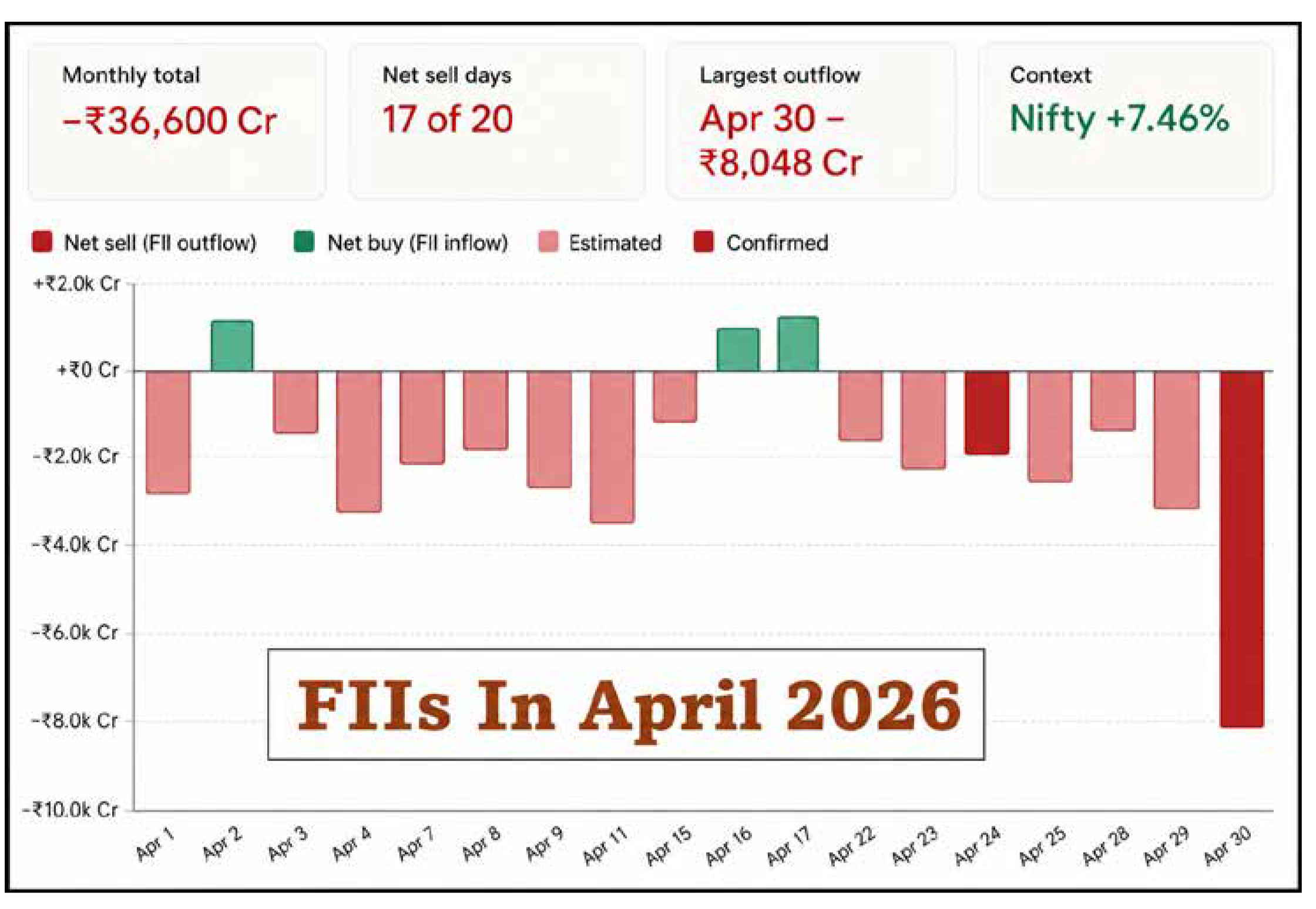
behaviour. FIIs continued to be aggressive sellers
throughout April, offloading equities worth
approximately ₹43,000–44,000 crore in the cash
segment. This sustained selling was a continuation of
the heavy outflows seen in March and reflected global
risk aversion, currency pressures, and relatively more
attractive yields in developed markets. Under normal
circumstances, such persistent FII selling would have
exerted significant downward pressure on the indices.
However, this time, domestic institutional investors
(DIIs) and retail participants played a crucial
counterbalancing role. DIIs invested over ₹34,000 crore
during the month, while steady inflows from retail
investors—particularly through systematic investment
plans (SIPs)—provided additional support. This created
a dynamic “tug of war” in the market, where FII selling
dragged indices down while DII and retail buying helped
stabilise and eventually push them higher.
Liquidity conditions and currency stability further
contributed to the positive momentum. While the Indian
rupee remained under pressure, it did not experience any
sharp or disorderly depreciation. The Reserve Bank of
India’s liquidity management measures, combined with
consistent domestic inflows, prevented any systemic
stress in financial markets. This stability allowed the
broader “India growth story”—characterised by strong
consumption, infrastructure development, and a robust
capital expenditure cycle—to regain prominence in
investor narratives. Public sector undertakings (PSUs)
and promoter-driven companies saw renewed interest
during the rally.
By the end of April 2026, the Sensex was trading in the
range of approximately 77,500 to 78,500, while the Nifty
settled between 24,100 and 24,400, marking a
substantial recovery from their March lows. The
momentum carried into early May as well. On May 4,
2026, after ending the previous week on a weak note,
markets opened strongly, with the Sensex rising over 997
points to touch 77,910 and the Nifty gaining 292 points to
reach 24,290 in early trade. However, investor sentiment
remained somewhat cautious due to the ongoing state
election results, which had the potential to influence
short-term market direction.
In summary, April 2026 represented a classic case of a
sharp correction followed by a strong technical and
sentiment-driven rebound. The recovery was fuelled by
easing geopolitical tensions, stabilising crude oil prices,
supportive domestic economic data, and strong
participation from domestic investors. Even though
foreign investors remained net sellers throughout the
period, their impact was effectively absorbed by
domestic flows, allowing the market to post its best
monthly performance in over two years. The interplay
between global uncertainties and domestic resilience
defined the market narrative, reinforcing the importance
of internal demand and liquidity in sustaining India’s
equity market momentum.